The Missing Piece in Mongolia’s Energy Transition
Nov 17, 2025
Enkhjin A., Namkhaidorj B.
As of 2024, approximately 91% of Mongolia’s electricity still comes from coal and CHP plants—a legacy of its Soviet-era, centrally managed energy system and the practical need to ensure reliable heat and power through long, harsh winters. While the grid reliably meets current demand, its original design did not anticipate today’s need for large-scale wind and solar integration. This creates a pivotal moment: addressing these structural limitations would unlock far greater use of Mongolia’s exceptional renewable resources, positioning the sector for a new phase of investment and growth.
Why Storage and Flexible Generation Matter?
Technical Role: Grid-scale storage—whether Battery Energy Storage Systems (BESS) or pumped hydro—provides the flexibility that Mongolia’s coal-centric system lacks. Storage enables energy shifting by charging during periods of high VRE output and discharging during peak demand. It delivers essential stability services such as rapid frequency regulation, inertia emulation, and fast ramping. Storage also mitigates VRE variability by smoothing solar drop-off and wind fluctuations, reducing damaging cycling on coal plants. Through peak shaving and localized buffering, storage can support Mongolia’s isolated grids and complement broader transmission upgrades, including the World Bank’s new 220 kV project that strengthens power transfer capability.
Economic Role: Greater flexibility lowers system costs by reducing coal plant cycling, easing wear-and-tear, and minimizing unnecessary fuel consumption. Lower curtailment risk enhances investor confidence and improves financing conditions for renewable projects. Storage assets can access multiple revenue streams—from capacity payments to ancillary services and arbitrage—while hybrid models such as co-located solar plus BESS can secure Power Purchase Agreements (PPAs) with firming revenue. As renewables scale, storage plays a central role in reducing emissions, improving ESG alignment, and enhancing the economic case for clean energy.
Storage and flexibility turn intermittent wind and solar into dependable system resources, allowing Mongolia to gradually shift from coal reliance toward a modernized, low-carbon grid. To enable this transition, upgrading the grid and deploying battery energy storage systems (BESS) are not optional—they are essential steps to elevate the current energy system to its next stage of performance and resilience.
Emerging Mongolian Projects
Several Multilateral Development Banks (MDBs) initiatives indicate a clear shift toward integrating storage and strengthening transmission.
What are the projects that are currently under implementation?
1. ADB’s Solar + Storage Projects
Key efforts include ADB’s first utility-scale energy storage project, along with the 115 MW solar and 65 MW / 237 MWh BESS development across the Western and Eastern Energy Systems. These projects represent Mongolia’s first large-scale solar-plus-storage auctions and provide the technical foundation for widespread VRE deployment.
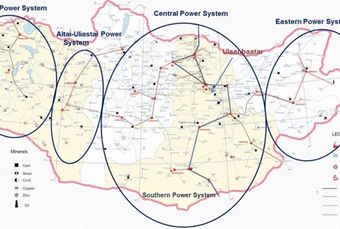
Source: NAPSNet Special Report
2. EBRD’s Renewable Auctions and Energy Strategy Cooperation
Momentum is reinforced by the EBRD’s expanded cooperation framework with the Government of Mongolia. Under a MoU signed by Deputy Prime Minister Togmid Dorjkhand and EBRD First Vice President Jürgen Rigterink, the parties committed to boosting competitive procurement of solar capacity and supporting Mongolia’s decarbonisation agenda. The Ministry of Energy, with EBRD assistance, plans to launch an auction for at least 100 MW of solar by end-2025, with a broader aim to develop around 500 MW of renewables by 2028 alongside necessary grid infrastructure.
In parallel, the EBRD and the government will cooperate on preparing a high-level energy sector strategy aligned with Mongolia’s Paris Agreement commitments—an initiative that strengthens policy clarity, reduces investor uncertainty, and further supports renewable integration and flexibility investments.
3. World Bank’s Fourth Energy Sector Project
The World Bank’s Fourth Energy Sector Project introduces a major boost to Mongolia’s transmission backbone. It includes a new 220 kV line between Mandal and the newly built Uvurkhangai substation, alongside upgrades in Mandalgovi, Arvaikheer, and Bayankhongor. These investments expand transmission capacity by approximately 590 MW, enabling around 150 MW of additional wind and solar generation. Beyond supporting new renewable projects, the upgrades are expected to improve reliability for roughly 200,000 people across the Central and Western regions, marking a meaningful step toward a more resilient and renewable-ready grid.
Collectively, these initiatives of ADB, EBRD and World Bank reduce first-mover risk, open pathways for storage investment, and create a more flexible and modern grid architecture.
Revenue Models for Storage and Flexible Assets
- Capacity Payments: Compensation for availability during peak demand or system emergencies—critical in a system with limited flexible resources.
- Ancillary Services: Frequency regulation, spinning reserves, and ramping support. While markets remain underdeveloped, early participants can benefit from emerging opportunities.
- Arbitrage: Charging during low-price periods and discharging during high-price periods. This opportunity will expand as VRE-driven price volatility increases.
- Merchant and Bundled Models: Co-located solar + BESS can combine PPAs with firming fees or grid-service contracts.
- Policy Needs: Mongolia still requires transparent ancillary market rules, clear capacity mechanisms, creditworthy PPAs, well-defined curtailment rules, proper storage classification, and dedicated tenders to attract large-scale investment.
Mongolia’s energy transition cannot rely solely on wind and solar deployment. Without grid-scale storage and operational flexibility, curtailment risks and reliability challenges will persist. ADB’s solar-plus-storage projects, the EBRD’s planned renewable auctions and sector-wide strategy work, and the World Bank’s major grid upgrades signal the beginning of a flexibility-oriented investment cycle. For investors, the most attractive opportunities lie in capacity payments, ancillary services, arbitrage, and hybrid renewable-plus-storage models. As Mongolia pivots toward a flexible, low-carbon energy system, early entrants in storage and grid-support assets are positioned to capture substantial long-term value.
Loading ...