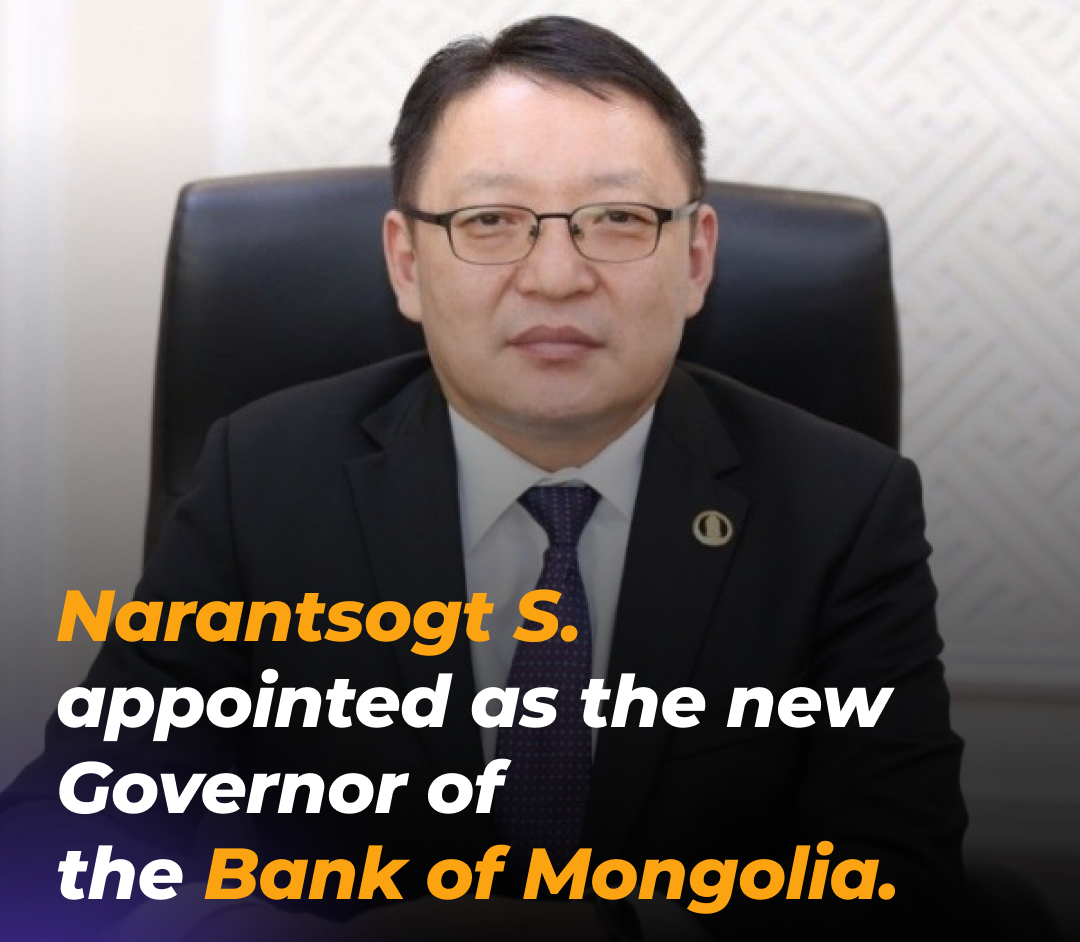
Narantsogt S. Appointed Governor of the Bank of Mongolia: Navigating Challenges in Monetary Policy and Market Stability
Dec 18, 2025
Tselmeg E.
In the December 18, 2025 session of Mongolia’s Parliament, Narantsogt S. was officially appointed as the Governor of the Bank of Mongolia, succeeding Lkhagvasuren B. The appointment received 79.8% parliamentary approval, reflecting broad—but not unanimous—support for his leadership during a period of macroeconomic challenges.
Narantsogt S. holds a Bachelor’s and Master’s from the National University of Mongolia and a Ph.D. from Seoul National University. His government and state-owned enterprise experience equips him to navigate Mongolia’s complex monetary and fiscal challenges.
Professional Background: Policy Experience Meets Management Roles
Narantsogt S.’s career spans over three decades across research institutions, government ministries, and state-owned enterprises:
- Early work in the Academy of Sciences (1993–1997) and Open Society Forum (1997–2000), followed by corporate management at IC LLC (2000–2003).
- Leadership positions in the Ministry of Finance, Ministry of Labor, Ministry of Education, Culture, and Science, and the Ministry of Economic Development, culminating in service as Deputy Minister and State Secretary.
- Executive leadership at Erdenes Mongol LLC (2022–2025), managing strategic financial initiatives and resource allocation.
Policy Record: Achievements and Limits
Narantsogt S. contributed to key fiscal and regulatory reforms, including:
- Drafting and implementing the Tax Code, National Wealth Fund Law, and Budget Law.
- Supporting improved debt management and fiscal discipline, which helped Mongolia meet certain international compliance benchmarks.
- Strengthening foreign currency reserves and attempting to improve export logistics.
During his parliamentary hearing, Narantsogt S. noted that past monetary expansion combined with aggressive fiscal growth contributed to inflation and asset bubbles. He emphasized the need to align fiscal and monetary policies more carefully. However, investors should note that Mongolia’s macroeconomic environment remains vulnerable to commodity price fluctuations, external shocks, and structural imbalances.
Vision for the Bank of Mongolia: Ambitious but Cautious
Narantsogt S. has outlined a vision for the central bank that emphasizes:
- Central Bank Independence – Strengthening regulatory oversight without excessive intervention in commercial banking.
- Market-Oriented Lending Programs – Reforming mortgage and targeted credit schemes to improve accessibility, while reducing dependence on administratively set interest rates.
- Macroeconomic Stabilization – Controlling inflation, addressing credit growth, and improving the efficiency of financial intermediation.
- Strategic Resource Management – Centralizing gold reserves as a buffer against external shocks.
While these priorities suggest a commitment to more predictable policy, investors should remain cautious: implementing structural reforms in a small and relatively underdeveloped financial market involves significant operational and regulatory challenges.
Investor Implications: Predictability, Transparency, and Market Confidence
For investors, Narantsogt’s appointment signals a commitment to predictable, market-oriented monetary policy. Key takeaways for the investment community include:
- Enhanced Regulatory Clarity – His approach promises transparent oversight, reducing systemic risks and improving credit market predictability.
- Support for Private Sector Growth – By promoting commercial bank lending efficiency and attracting foreign investment, the central bank aims to improve capital market liquidity and accessibility.
- Macroeconomic Stability – Coordination of fiscal and monetary policy under his leadership is expected to control inflation and mitigate asset bubbles, improving Mongolia’s investment climate.
- Strategic Resource Management – Centralizing gold reserves and leveraging digital systems to curb the shadow economy enhances national financial resilience.
Narantsogt also highlighted the need for structural reforms in mortgage lending and pension-related credit, advocating for open, market-aligned frameworks rather than administratively imposed solutions, reflecting a pragmatic and investor-friendly approach.
With a six-year term ahead, Narantsogt S. is poised to lead the Bank of Mongolia through a pivotal period of macroeconomic stabilization and capital market development. His record of digital innovation, fiscal discipline, and strategic leadership at state-owned enterprises suggests a stronger regulatory environment and a more stable macroeconomic landscape. For investors, this leadership transition signals greater transparency, improved predictability, and a supportive environment for private and foreign investment, laying the groundwork for sustainable economic growth in Mongolia.
Loading ...
.png)