Geography is Not Destiny: Mongolia’s Critical Minerals Moment
Feb 10, 2026
Ariunzaya O.
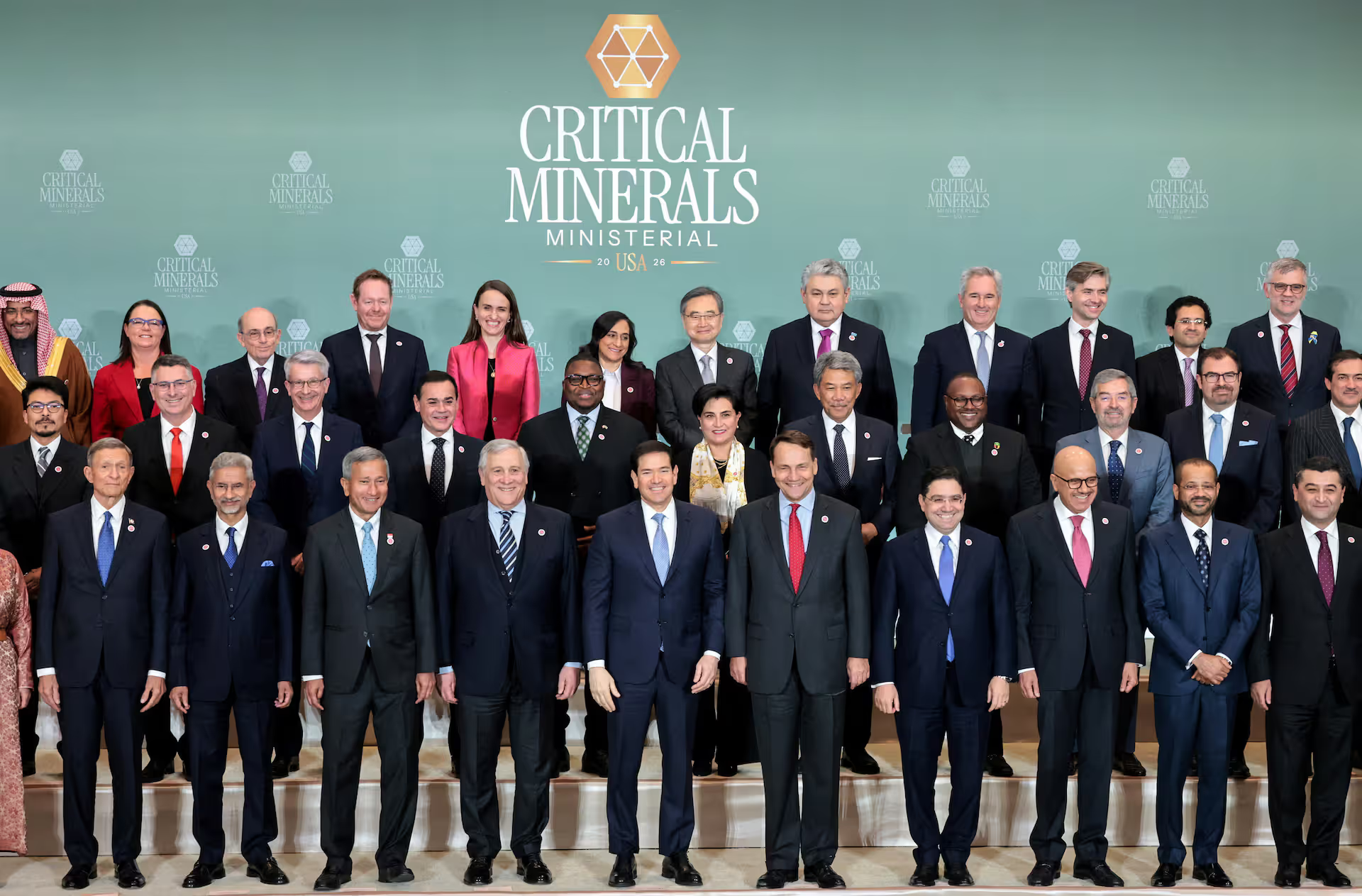
The 2026 Critical Minerals Ministerial in Washington brought together more than 50 nations, from Mongolia to Angola, to discuss forging critical minerals supply chains less exposed to Chinese market dominance. Vice President JD Vance proposed a mechanism to return the global critical minerals market to a “healthier, more competitive state” through establishing a “preferential trade zone” with enforceable price floors and granting members the foundation for private financing and secure access to critical minerals.1 The United States signed 11 new bilateral frameworks or memorandums of understanding (MOUs)2 at the event with countries including Argentina, Ecuador, Uzbekistan, Morocco, Peru, and the Philippines. It also relaunched the U.S.-led Minerals Security Partnership as FORGE, a coalition of countries focused on rapidly scaling up public and private investment across critical minerals supply chains, chaired by South Korea.3
“Our goal here – and the reason why we’re doing this conference – is to align trade policy, development finance, and diplomatic engagement towards a shared strategic objective. And that objective is very simple: diversifying global supply in the critical minerals market while strengthening the partner countries who help all of us in this shared effort,” Vance stated in the opening remarks of the ministerial.
Vance expressed his wish to form a trading bloc among American allies and partners that expands production across the entire bloc.
“What is before all of us is an opportunity at self-reliance, that we never have to rely on anybody else, except for each other, for the critical minerals necessary to sustain our industries and to sustain growth,” Vance added.
Though the ambition of the ministerial is clear, the details appear scarce. As the Natural Resource Governance Institute has observed, "it is unclear whether the initiative will secure the political and economic buy-in from major producing and consuming countries to move forward."4 Timelines ranging from 30 days to six months have been outlined for the development of MOUs and action plans related to the proposed mechanism.5
The Opportunity to Reframe the “Geographic Trap”
Despite the initiative remaining more aspirational than concrete, for Mongolia, its importance lies less in its immediate results than in what it signals. The ministerial meeting serves as a stark reminder that interest in non-Chinese critical minerals supplies has very much materialized into a pressing strategic priority in Washington, Tokyo, and Seoul, among others. This heightened interest in the critical minerals supply chain appears to present Mongolia a leverage to advance its national interests: economic growth and the preservation of sovereignty.
Mongolia is richly endowed with copper, uranium, fluorspar, rare earths, and other critical minerals.6 The country hosts Oyu Tolgoi, which is expected to become the fourth largest copper mine in the world by 2030. France's Orano is moving toward uranium production by 2028 under a $1.6 billion agreement with the Mongolian government. The country leads in fluorspar reserves and holds proven deposits of rare earths and other minerals deemed critical by advanced economies.
Yet, looming in the background of this impressive resource endowment, is the geographic reality that Mongolia is doubly landlocked between Russia and China. Every mineral export must transit through one of its two neighbors. This reality has long shaped Mongolia’s economic and diplomatic calculations, reinforcing the perception that geography imposes hard limits on how much autonomy the country can exercise.
While the ministerial has not yet offered concrete instruments nor eliminated this geographic constraint, it nevertheless challenges this defeatist perception. For years, Ulaanbaatar has fatefully pursued its Third Neighbor Policy to balance its precarious position diplomatically. What the current moment offers is the possibility/opportunity of extending that policy into the economic domain.
If Mongolia can develop its mining sector in ways that create shared interests with powerful third parties, it gains a form of leverage that goes beyond diplomacy. Mongolian leaders should thus be seriously evaluating how to turn this heightened strategic interest into concrete strategy.
Mongolia has already taken a few preliminary steps in doing this over the years. It held a trilateral Critical Minerals Dialogue with the United States and South Korea, established a rare metals cooperation framework with South Korea, signed a memorandum with the United Kingdom on rare earths research, and maintains strategic partnership ties with Germany.7 However, memorandums alone aren’t equal to securing indispensable roles in supply chains, as true economic leverage can emerge only when security, diplomacy, and commercial interests are at stake.
If Mongolia manages to redistribute risk through embedding its minerals in global supply chains that have strategic importance to other states – or creating economic leverage – then its geographical burden can be partially shared. The uranium deal with France demonstrates how this could work. Pursuant to an agreement between France and China, Mongolian uranium is expected to transit through China to reach France – an arrangement that functions because a major third party has a strong interest in keeping the route open. When the demand is strategic, when the United States, EU, Japan, or South Korea genuinely need diversified sources outside Chinese control, Mongolia’s geography can become a coordination problem that partners have incentive to solve.
The ministerial signals that this strategic interest exists. However, realizing this interest into something more durable is a two-sided endeavor. Whether it translates into durable arrangements through infrastructure, financing, and diplomatic support will depend on many factors including how willing Mongolian leaders are to articulate Mongolia’s aspirations into an actual strategy – indeed, Mongolia’s readiness to play an active, assertive role is the core prerequisite. Which minerals and partners should be prioritized, and where can processing and value-addition be pursued to generate economic leverage? Could Mongolia coordinate more closely with existing regional frameworks such as the C5+1 or develop new partnerships that align with its national objectives? How can the country act smartly and swiftly to transform this moment of attention into lasting economic and geopolitical gains? These questions may not have simple answers, but they are precisely the ones Mongolian leaders must urgently confront if this strategic moment is to be fully realized.
The Execution Question
The ministerial offers genuine opportunities including capital access, offtake agreements, policy coordination,8 but the challenges are equally real. Developing mines is a slow endeavor: globally, mines take an average of 16.3 years9 from discovery to production and nearly three decades in the United States. At the ministerial, Washington made clear its intent to compress permitting timelines and inject strategic urgency into its mining sector. Mongolia, if it attempts to match this pace, will face pressure to accelerate on mines, plants, and infrastructure while its courts, local communities, and administrations, where opposition to mining is often the strongest, continue to operate at a slower pace.10 At the same time, Mongolia must yet again navigate a delicate balance of deepening economic integration with Western partners without triggering retaliatory measures from its two immediate neighbors.
If these challenges can be overcome, however, the payoff could be substantial. By embedding its minerals in supply chains that matter strategically to others, Mongolia can begin to generate real economic leverage. If the constraints imposed by geography become a shared problem among partners, Mongolia would be able to advance its national interests from far firmer footing.
2 https://www.state.gov/releases/office-of-the-spokesperson/2026/02/2026-critical-minerals-ministerial
3 https://www.chosun.com/english/world-en/2026/02/06/XXBSFARWFRGI3CF7Z5ZZ5QRBOE/ ; https://www.cfr.org/articles/u-s-allies-aim-to-break-chinas-critical-minerals-dominance
6 https://www.lowyinstitute.org/the-interpreter/mongolia-s-critical-role-global-energy-transition
7 https://www.reuters.com/world/germany-mongolia-enter-into-strategic-partnership-2024-02-07/
10 https://geopoliticalmining.com/welcome-to-the-era-of-u-s-geopolitical-mining/
Photo from: https://www.reuters.com/sustainability/sustainable-switch-us-eu-stockpile-critical-minerals-2026-02-06/
Loading ...
.png)