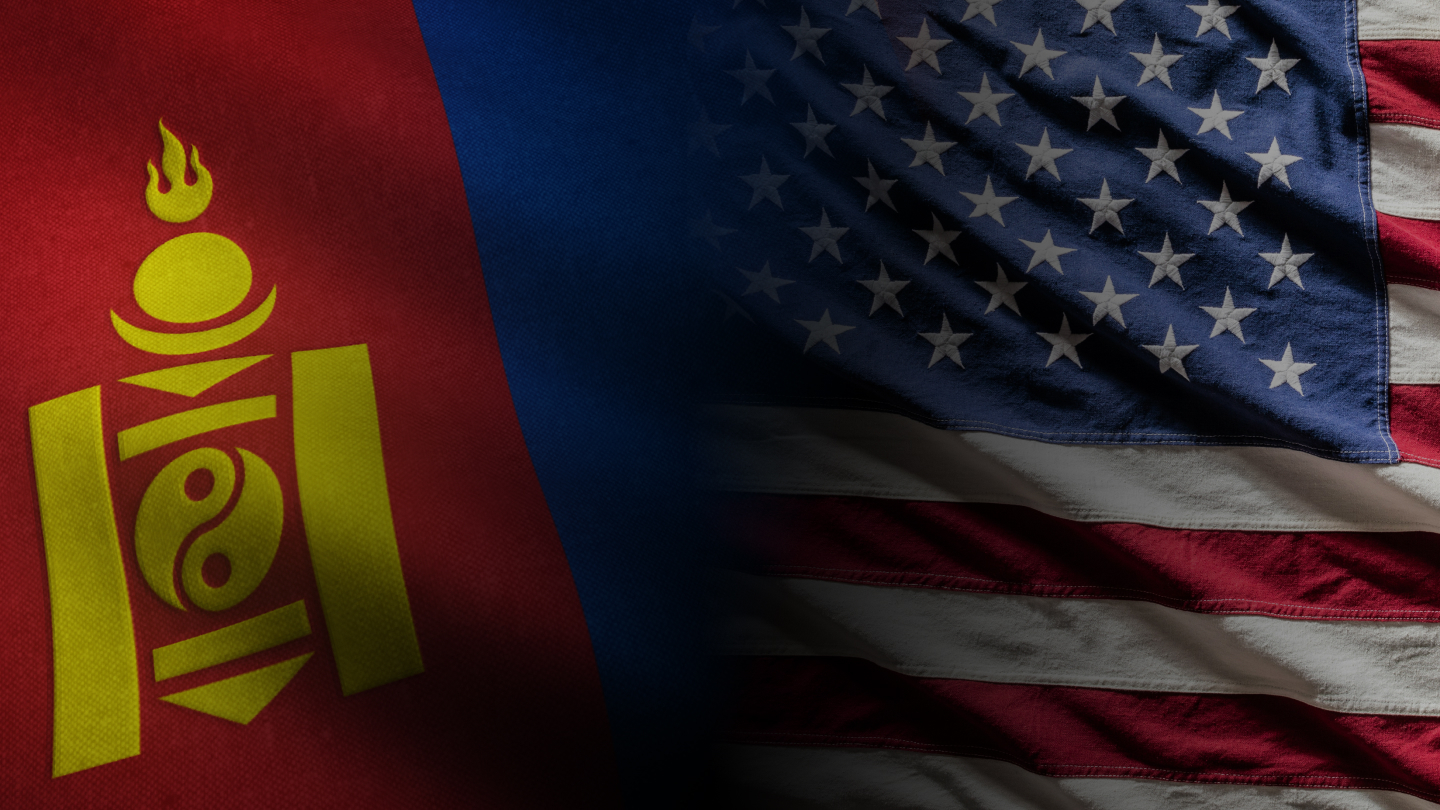
Beyond Symbolism: Why Mongolia and the United States Need Real Commercial Diplomacy
Mar 26, 2026
Zolbayar E.
Core argument: the visa bond episode is not only a consular issue. It is a warning that Mongolia’s relationship with the U.S. remains politically warm but commercially too thin, and that both sides now need far more serious commercial diplomacy and policy engagement.
The recent U.S. decision to place Mongolia under the visa bond program has understandably caused frustration in Mongolia. For many Mongolians, the move feels inconsistent with years of language about strategic partnership, democratic solidarity, and Third Neighbor cooperation. But the deeper significance of this episode is not consular. It is structural. It reveals how shallow the commercial foundations of the U.S.-Mongolia relationship still are, and why that now matters more than before.
Overstay may be the official trigger, but it does not offer a full explanation. Even if overstay rates were part of the rationale, the decision is likely the result of a U.S. policy environment that is becoming more selective, more transactional, and more openly centered on hard interests. Countries with stronger business ties, clearer strategic economic relevance, more organized lobbying, and deeper policy engagement tend to have more tools in their arsenal to defend their strategic interests and remain visible in Washington. In contrast, Mongolia remains largely absent from the thinking of Washington media and policymakers.
Commercial diplomacy matters more now
This is the first point Mongolia should absorb clearly. In recent U.S. policy language, commercial diplomacy is no longer a secondary function of foreign policy. It is moving closer to the center. In official remarks at the 17th Corporate Council on Africa U.S.-Africa Business Summit, Ambassador Troy Fitrell said that commercial diplomacy was being made a top priority for every U.S. ambassador in Africa and that success would be measured by “deals delivered – not cables written.” Fitrell's speech serves as one of the clearest recent statements of how Washington increasingly thinks: not only in terms of values and goodwill, but in terms of investment, projects, exports, infrastructure, and commercially meaningful relationships.
The same logic is visible in the State Department’s broader framing of “America First in Africa.” Whether one agrees with this approach or not, the message is unmistakable: symbolic ties do not carry enough weight on their own. If a country wants to matter more in Washington, it increasingly needs to matter in practical economic terms.
The commercial base of the relationship remains too thin
This is precisely where Mongolia’s problem lies. According to Mongolia’s National Statistics Office, bilateral trade turnover with the U.S. was around $543 million in 2025, representing only 2.0% of Mongolia’s total trade turnover. For a relationship so often described in strategic terms, this is still a very modest commercial base. The political language of the relationship has run far ahead of its economic substance.
At the institutional level, the bilateral architecture exists but remains under-realized. The USTR’s Mongolia page shows that the countries still rely on the Trade and Investment Framework Agreement and the Bilateral Investment Treaty as key pillars of the economic relationship. Yet Mongolia still does not have a flagship U.S. strategic investment in infrastructure, energy, or industrial capacity. Nor has it attracted the kind of major American corporate presence that would naturally advocate for a deeper bilateral economic agenda. In practice, the relationship has goodwill, but not yet enough commercial substance.
This is the uncomfortable reality behind the visa bond episode. Mongolia is not being judged only through the language of partnership. It is also being judged through the weight it carries inside a system that is increasingly driven by economic relevance and strategic prioritization. Where that weight is limited, a country becomes easier to overlook, easier to place into blunt policy buckets, and harder to defend through practical influence.
This is also why think tanks matter
It is naive to assess commercial diplomacy through the lens of embassies, ministers, and trade officials. Commercial diplomacy subsists on the vibrant ecosystem around policy: think tanks, business councils, research institutions, media platforms, lobbying channels, and the steady production of English-language policy papers and briefings play a pivotal role in ensuring a country remains salient to Western decision-makers. This is where Mongolia faces a second gap. The think tank and policy-engagement space between Mongolia and the U.S. remains thin to the point of near-invisibility.
This gap matters as policy influence is a cumulative endeavor. It is built not only through high-level visits, but also through repeated exposure, briefings, relationship-building, and institutional memory. In this respect, Mongolia should look to the example of Central Asia. Think Mongol’s own analysis of how Central Asian countries are lobbying and engaging the White House points to a more deliberate effort by those states to cultivate policy relevance in Washington. Recent Reuters reporting on U.S.-Central Asia engagement and on the U.S.-Uzbekistan critical minerals pact reinforces the same broader point: countries that connect diplomacy with minerals, infrastructure, financing, and business opportunity tend to command more attention.
Mongolia does not need to imitate Central Asia mechanically. Yet, it should internalize the underlying lessons. Symbolic diplomacy is simply not enough in recent times. Mongolia urgently needs organized policy production, better elite engagement, stronger institutional links, and a clearer commercial proposition. Think tanks have a direct role in that process, as they frame national interests, produce policy language, shape debates, convene stakeholders, and keep a country intellectually present between official visits.
This is not only about the United States
The lesson extends beyond Washington. Mongolia needs a more serious commercial diplomacy strategy with all of its important partners: the U.S., Europe, Japan, South Korea, India, the Gulf, and other strategically relevant countries. For each case, the central question should remain the same: how does Mongolia convert diplomatic goodwill into durable economic stakes?
The answer to this question lies in both commercial diplomacy and policy diplomacy. Commercial diplomacy means actively building pipelines for investment, trade, infrastructure finance, project origination, and business relationships. Policy diplomacy means ensuring that Mongolia is understood in foreign capitals through ideas, papers, data, briefings, and institutional partnerships. These two spheres of diplomacy should work in tandem, and without that dual effort, Mongolia risks continuing to practice symbolic diplomacy relatively well while underinvesting in the structures that actually protect national interests.
Why this matters for both sides
For the U.S., the case is strategic as much as economic. As the popular saying goes, Mongolia is an island of democracy sandwiched between two authoritarian powers. If Washington genuinely values democratic resilience in strategically sensitive regions, then Mongolia should matter not only in rhetoric but also in economic practice. A more economically resilient Mongolia is also a more strategically resilient Mongolia.
For Mongolia, the rationale is even more immediate. Mongolia’s core vulnerability remains overdependence: dependence on narrow export channels, concentrated financing relationships, and limited external options. Reducing dependency risk therefore requires more than diplomatic balance. It requires diversification in capital, technology, infrastructure partnerships, and long-term investment. That is why U.S. participation matters, particularly in infrastructure, power generation, grid modernization, logistics, storage, industrial processing, and the broader energy transition. Mongolia does not merely need another friendly statement from Washington. It needs a stronger American economic stake in Mongolia’s future.
From slogans to structure
The practical implication is straightforward. Mongolia should stop assuming that strategic language automatically leads to strategic outcomes. It does not. Relationships become durable when they are backed by projects, investors, institutions, and ideas. That means Mongolia needs more active investor outreach, more English-language policy production, more sector-specific briefs, more Washington-facing engagement, and clearer investable propositions for the U.S. and other international partners.
This is also why the private sector, research institutions, and policy entrepreneurs matter so much. Governments can open doors, but they do not by themselves create the full architecture of influence. That work is also done by think tanks, advisory platforms, investors, media channels, and business forums that repeatedly put a country in front of decision-makers and help translate abstract interest into concrete opportunity.
Why CMM’s New York forum matters now
This is precisely why CMM’s Third Annual Mongolia Investment Forum in New York matters now. In the current environment, commercial diplomacy is not a luxury add-on to political relations. It is the missing middle between rhetoric and results. Forums like this help convert diplomatic goodwill into investor attention, policy dialogue into project pipelines, and symbolic partnership into practical engagement. They create a place where policymakers, investors, companies, and sector experts can meet around actual opportunities rather than general sentiment.
If Mongolia wants the U.S. relationship to carry more weight in Washington, it needs more sustained efforts of exactly this kind. The answer to the visa bond episode is not only to protest the decision. It is to build the kind of bilateral relationship that becomes harder to treat casually in the future. That means more commerce, more capital, more policy engagement, more think tank activity, and more long-term strategic seriousness on both sides.
The real lesson of this moment is therefore larger than visas. It is that actions must finally catch up with slogans. If Mongolia and the United States want their partnership to be meaningful in a harder, more transactional world, they need to build it on something stronger than symbolism alone.
This is why CMM’s New York forum is important — and why investors, companies, policymakers, and partners should participate.
Loading ...
.png)