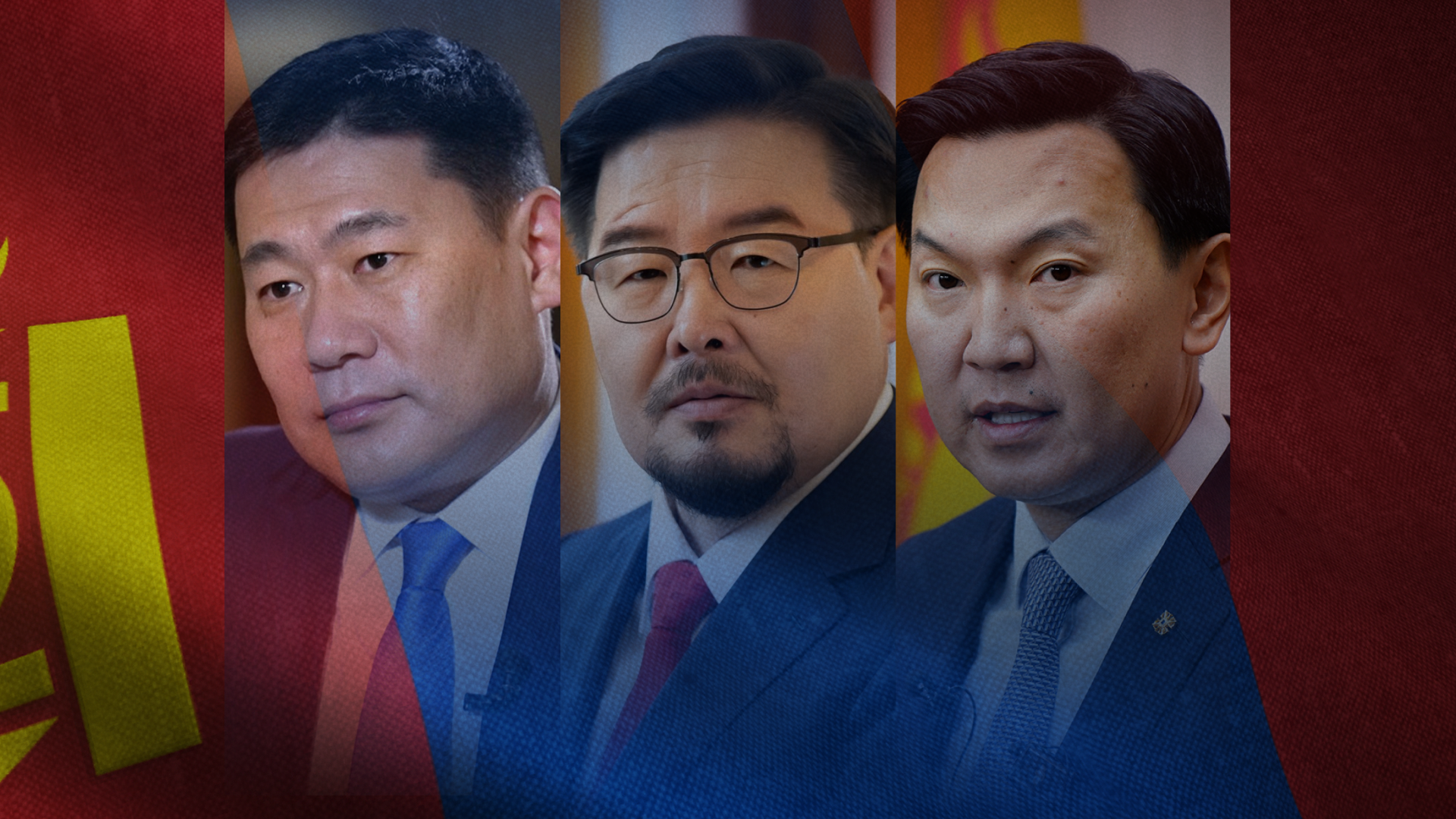
Three Prime Ministers in Less Than a Year: What’s Next for Mongolia?
Mar 30, 2026
Zolbayar E.
Mongolia is about to have its third Prime Minister in under twelve months.
For foreign investors, that headline triggers a familiar conclusion: instability, policy risk, and another reminder that Mongolia remains politically fragile. That reading isn't wrong, but it isn't complete either.
Not all political transitions are created equal, and this one, more than most, deserves a closer look.
This wasn't just routine turnover
G.Zandanshatar's resignation wasn't simply a routine political turnover. It reflected something deeper, a genuine tension baked into how Mongolia's political system operates. The opposition had been pushing a clear argument: the chairman of the ruling party should not simultaneously serve as Speaker of Parliament. In a multi-party system, the legislature cannot credibly function if its leadership is concentrated in the hands of the ruling party’s head. That pressure was real, but pressure alone rarely forces anyone out.
What actually made it decisive was friction inside the Mongolian People's Party (MPP) itself. The opposition opened the door, and the MPP's internal dynamics pushed Zandanshatar through it.
This wasn't just one Prime Minister stepping aside. It was a broader reshuffling of power at a particularly sensitive moment in Mongolian politics.
Mongolia is now entering a critical electoral cycle: a presidential election in 2027, followed by parliamentary elections in 2028. Zandanshatar had been widely seen as a leading presidential candidate from the MPP, particularly if he could keep his cabinet stable through 2026 and demonstrate governance credibility. That trajectory is now gone, and for the first time in months, the party doesn't have a clear candidate heading into the presidential cycle. Investors are right to notice that uncertainty.
Not another disruption, more likely a consolidation
All roads from this rebalancing point toward one person: Nyam-Osor Uchral.
If the current logic holds, Uchral has little real choice but to become Prime Minister. Uchral currently holds both the Speakership and the MPP chairmanship, which is precisely the concentration of power that became politically untenable. Moving him into the Prime Minister's office while stepping down as Speaker resolves that contradiction cleanly, and there are few obvious alternatives to that path.
For investors, the question that follows is whether this shift fragments Mongolian governance further or begins to consolidate it.
Mongolia's persistent problem has never been a shortage of ideas. Policies get announced, strategies get drafted, frameworks get launched. What consistently falls apart is execution, because cabinets change too fast and power is too dispersed for political alignment to last long enough to carry anything through. If Uchral's rise reduces that fragmentation, even at the margins, it is meaningful to investors.
Why Uchral could be good for investors
Uchral isn't an outsider parachuting into a system he doesn't understand. He is the system, and that, somewhat counterintuitively, may be exactly why markets are likely to respond to him positively.
He comes with a track record of execution on a major strategic project. The Orano uranium deal required sustained legal changes, complex political coordination, and genuine state alignment over time, and Uchral was a key part of that process. That alone puts him ahead of most Mongolian political figures in terms of credibility with investors.
He also understands the structural weaknesses of Mongolia’s capital markets. His support for private pension reform signals an awareness that long-term market development requires long-term domestic capital. For fixed income investors, this is critical.
He appears more open to modernization than many traditional political operators. His background spans digital governance, administrative reform, and increasingly, green financing and energy transition. This suggests a pragmatic, forward-looking approach rather than a purely political one. And most importantly, he has power. As both party chairman and Speaker, he sits at the intersection of Mongolia's key governing institutions, and if he becomes Prime Minister, he will be one of very few figures capable of aligning the party, the parliament, and the government simultaneously. For investors, that matters more than any particular ideology.
Cabinet: continuity with some deliberate resets
The next cabinet will determine whether this transition leads to stronger execution.
Our base case is that Uchral keeps most ministers in place, because continuity is the rational call. But continuity alone won't be enough. After yet another abrupt leadership change, he needs visible movement in a handful of key portfolios to restore confidence and signal that he's genuinely in control. Think of it as a continuity cabinet with targeted resets at the edges.
Justice is the clearest candidate for change. Replacing B.Enkhbayar would be the most immediate and low-cost way for Uchral to signal a political reset, and the replacement is likely to be a more neutral, experienced MPP figure, or someone who lowers political temperature rather than adding to it. This is less about policy and more about restoring confidence in governance.
Finance is more nuanced. B. Javkhlan's multi-cabinet tenure makes him both a symbol of stability and a natural rotation point, particularly as criticism of fiscal policy has grown. Uchral has two realistic options here: keep him to signal continuity to markets, or reposition him into a broader economic role. The latter seems for probable, with someone like G.Temuulen representing generational shift, or Ch.Khurelbaatar, a former finance minister with experience and current proximity to Uchral within the party, stepping in. For investors, the individual matters less than the question underneath: does fiscal discipline hold?
The Economy and Development portfolio, central to Uchral’s control over execution, is one Uchral knows intimately, having led it before, and it is likely to move closer to his political core. If Javkhlan rotates out of Finance, this would be the natural landing spot, though the role could also be restructured to concentrate economic coordination more tightly around the Prime Minister's office.
Environment and Climate Change has quietly become strategically important. Uchral has been visibly active on green financing, carbon frameworks, and energy transition, and with COP17 approaching, this ministry has moved from the periphery toward the center of Mongolia's international positioning. He will want it firmly under MPP control, not because of any weakness there, but because of its growing strategic value.
The most politically sensitive area, however, is the coalition portfolios, particularly Energy and Education.
Before the government collapsed, Zandanshatar had already been working a reshuffle: Energy Minister B. Choijilsuren was set to be replaced by HUN's B. Naidalaa, while HUN's P. Naranbayar in Education was likely heading out in favor of MPP's L. Enkh-Amgalan. Those changes never cleared parliament, but they reveal the direction of travel, essentially a ministry swap between MPP and HUN, with HUN picking up Energy and MPP reclaiming Education. That whole negotiation is now back on the table.
Energy is the most critical ministry in this context. It sits at the heart of Mongolia’s reform agenda, investment pipeline, and structural constraints. Deputy PM and HUN leader T.Dorjkhand has been spearheading energy reform since 2024 and has strong incentives to secure the ministry for his party. At the same time, Uchral himself has been active on energy transition and green financing, making it less obvious that MPP would want to concede such a strategic portfolio.This negotiation will determine whether HUN remains meaningfully inside the cabinet or whether MPP moves toward tighter, more centralized control.
Uchral's broader balancing act is a delicate one. He needs enough continuity to reassure investors, and enough visible change to restore political credibility and assert real authority. Too little change looks like more of the same instability. Too much introduces new uncertainty of its own. The likely outcome sits somewhere between those poles, a largely intact cabinet reshaped at the specific points where political cost is highest and strategic value is greatest.
The only question that matters
At first glance, Uchral looks like a positive development for investors: more pragmatic, more experienced in execution, more powerful politically, and more open to reform.
But that isn't really the question worth asking right now.
The real question is simpler and harder: can he build a government that lasts through 2028?
Because that is now his political horizon. Zandanshatar’s path was tied to the 2027 presidential election. Uchral’s is different. His task is to hold power through the parliamentary cycle: to stabilize the government, deliver visible results, and lead the MPP into the 2028 elections.
That is a harder test. Can he maintain parliamentary alignment after stepping down as Speaker?
Can he keep the ruling party unified? Can he manage coalition tensions without another collapse?
If he can, this moment might represent something genuinely different, not a policy shift, but a shift in Mongolia's underlying capacity to execute. If he cannot, the country returns to a pattern that investors already know far too well.
For fixed income investors, that is the lens that matters most. Mongolia's opportunity has never really been in question. Its execution has. Uchral may improve the odds, and now he has to prove it.
Loading ...
.png)