Five years ago, Mongolian NBFIs were barely on the radar of international investors. Recently, several of them have landed on term sheets from IFC, FMO, and a Singapore-based fintech fund, and one has issued a bond in South Korea.
International investors have quietly moved close to $100 million into Mongolia's NBFI sector since the start of 2025, spread across development finance institutions, impact funds, and Asian debt platforms most Mongolian companies had never had access to before. It's a small number by global standards. In a sector that barely registered on foreign radars five years ago, it's a signal.
Why now
The timing isn't an accident. Mongolia's NBFI sector has been the fastest-growing corner of the country's financial system for years: loan books expanding at a 38% CAGR since 2021, nearly double the 21% pace of the banking sector, even as NBFIs still account for less than 10% of total banking-sector assets. That's a sector with room to run and a growth rate that's hard to find elsewhere in frontier credit markets.
It's also a sector that just got a lot more disciplined. Between early 2025 and January 2026, Mongolia's Financial Regulatory Commission and the Bank of Mongolia rolled out the most consequential set of NBFI rules in the sector's history: a ban on raising capital from domestic banks and money lenders, a 60% debt-to-income cap on consumer loans, and a 20% minimum capital adequacy requirement. For operators without an alternative funding source, that domestic funding ban is existential. For the ones who'd already built international capital relationships, digital-first lending models, and governance that meets outside disclosure standards, it's a moat.
Three companies illustrate how that capital found its way in.
- Invescore NBFI JSC (MSE:INV) was Mongolia's first NBFI to seriously court foreign capital, and 2025 was the year that bet started paying off at scale. The company, celebrating its 10th anniversary in 2026, secured $58 million in disclosed financing during 2025 from a run of European and Asian institutions: $5 million from Dutch impact investor Triple Jump, $16 million total from EMF Microfinance Fund, $20 million from the Netherlands Development Finance Company (FMO), $5 million from Triodos Investment Management, and $25 million into its Pocket NBFI subsidiary from Singapore-based Helicap. Five separate international backers, five separate votes of confidence, inside a single year. That momentum carries into London this year: InvesCore's parent company, ICFG Limited, is the presenting partner of the Mongolia Investment Forum: London 2026.
- LendMN NBFI JSC (MSE:LEND) has spent since 2017 building an AI-driven underwriting model that turns loan approvals into a mobile-app transaction, and its funding base now reflects a similarly diversified, tech-investor logic. The company drew $41.81 million in international funding across 2025 and into 2026: a $20 million facility from Lendable Asset Management in two tranches, $10 million from Kilde across six disbursements, $9 million from Alternative Investments VCC, and additional financing from DWM Asset Management, on top of an earlier $21.4 million Series B led by IFC and AEON Financial Service. It's also one of the more interesting impact stories in the sector: 72% of its MSME borrowers are female-owned, and 92% of clients reported rising income or sales in 2025. AND Global Pte. Ltd., LendMN's parent, is also a presenting partner of the Mongolia Investment Forum: London 2026.
- Sendly NBFI JSC (MSE:SEND) took a slightly different route. Rather than raising equity or drawing debt facilities, Sendly went to the capital markets directly, launching a secured 24-month public bond on the MSE, and then becoming the first Mongolian company to issue an "Arirang" bond in South Korea, a 10-year, KRW 2 billion (~$1.45 million) instrument. A Bond 3.0 issuance is already in preparation for this September. Sendly will also take part in the Mongolia Investment Forum: London 2026 as a participant.
The bigger pattern
None of this happened in isolation. It's the product of a sector reaching the scale and governance maturity where international capital starts paying attention, and a regulatory environment now actively selecting for exactly that combination. The NBFIs still growing share three things: international funding pipelines, digital-first models, and disclosure standards that meet outside scrutiny. That's a narrower field than it was two years ago, but a more investable one.
For a market this early in its international story, three companies raising close to $100 million combined, opening a Korean bond market, and building out MSME lending at a 30%+ annualized re-lending rate isn't a rounding error. It's what a breakout funding run in a frontier credit market actually looks like.
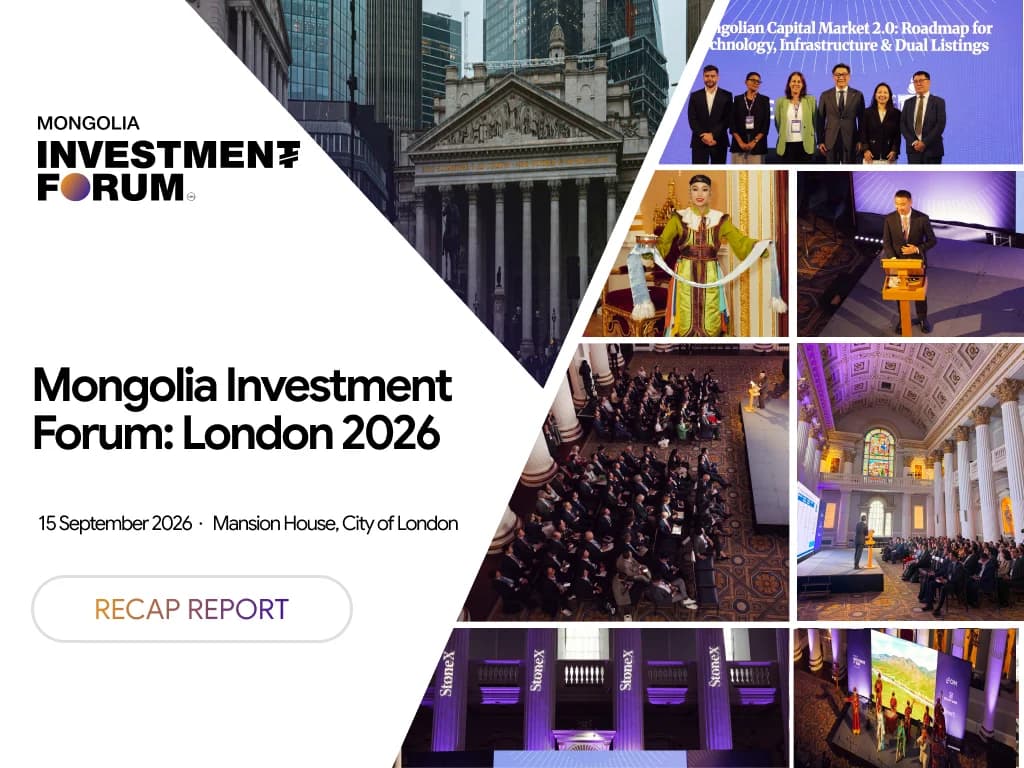
Click here to request an invitation to Mongolia Investment Forum: London 2026.
This article draws on information from “CMM’s Investor's Guide to Mongolia: NBFIs” (September 2026 Edition, Q2 Update). Click here to read the report.