Mongolia's New Cabinet Is Assembled. Now Comes the Hard Part.
Apr 7, 2026
Tselmeg E.
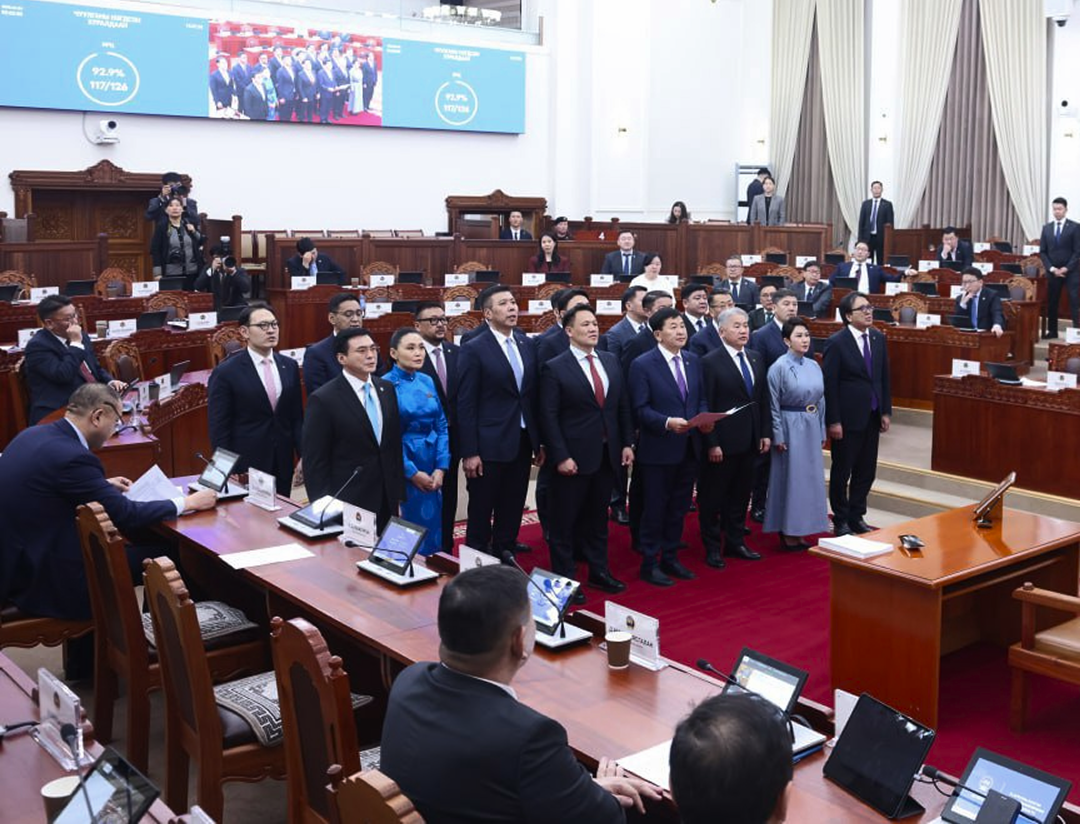
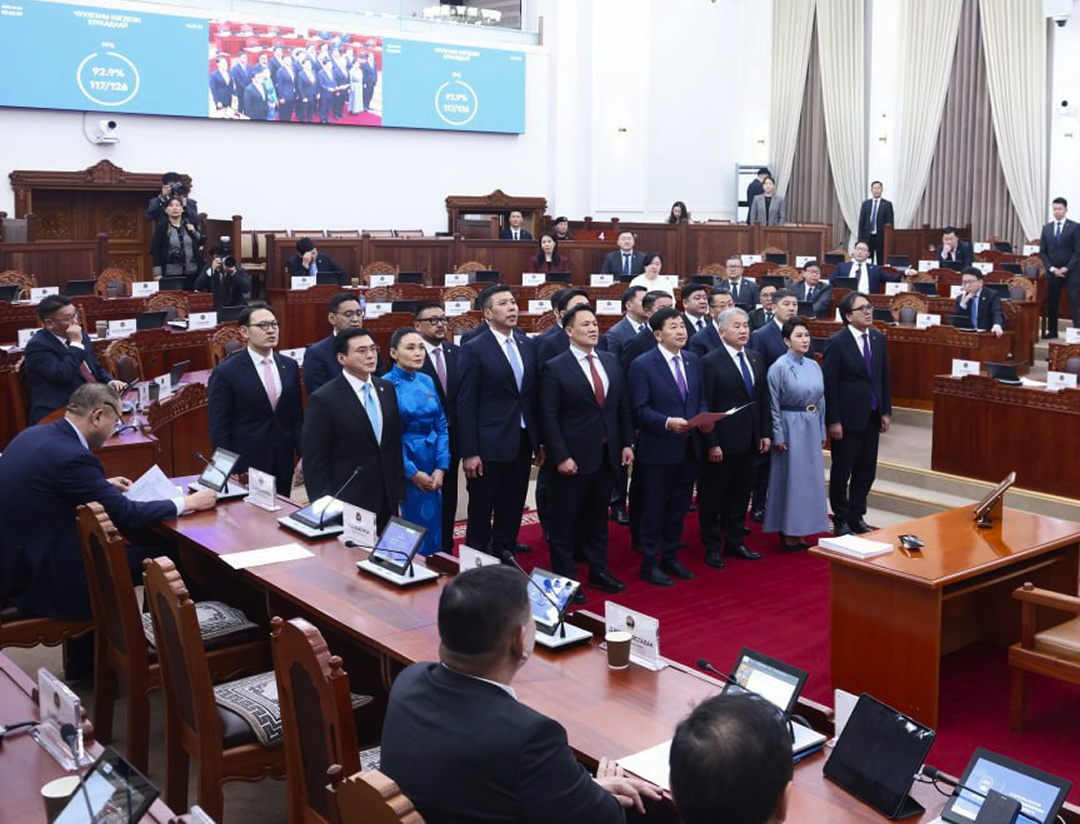
Mongolia's 35th government was sworn in at 2:24 in the morning on April 4 — an unglamorous hour that perhaps captured the mood. Prime Minister Uchral N., confirmed by parliament just days earlier as the country's third prime minister in nine months, presented a 19-minister cabinet drawn from three parties: 16 from the ruling MPP, two from the Hun Party, and one from the National Coalition, spanning 16 ministries. Uchral N. framed the moment plainly: the government walks in facing a "triple crisis" of rising fuel prices, commodity market volatility, and domestic political fragmentation.
10 Ministers Held Over, 9 New Faces: Reading the Cabinet for Policy Signals
The most telling number in this cabinet is ten — the ministers carried directly over from the Zandanshatar G. government that collapsed just days ago. In a country that has now cycled through three prime ministers in nine months, the continuity is deliberate. Uchral N. told parliament he prioritised speed and stability over a clean slate, noting that mid-crisis reshuffles generate legal disputes, transitional costs, and lost momentum. On that logic, the holdovers make sense.
The Ministers That Matter to Investors
Minister of Industry and Mineral Resources — Damdinnyam G. (holdover): The most consequential holdover for markets, and the one investors should watch most closely. Damdinnyam G. is a mining man in the fullest sense and has spent his tenure pushing one of the most sweeping reform agendas the sector has seen. Since taking office, he has been driving amendments to the Minerals Law as the centrepiece of his reform agenda — one of five key pieces of legislation he has targeted for overhaul. On royalties, the agenda is specific: restructuring copper royalty progressive payments to international standards; setting appropriate rates on processed and beneficiated products to incentivise domestic value-added manufacturing; aligning royalties on co-occurring elements with global norms; and channelling a greater share directly to the aimags and communities where extraction actually takes place. The broader direction is a deliberate shift away from equity-heavy agreements toward royalty-based structures — a model he has pointed to explicitly via the recent Orano uranium deal. He remains the government's point man on the Oyu Tolgoi renegotiation with Rio Tinto, which carries a first-half 2026 deadline. His position on Mongolia's benefit share: 53%, non-negotiable.
Minister of Finance — Mendsaikhan Z. (new): A first-time minister with a domestic economics background and prior roles spanning public investment, energy sector administration, and presidential advisory work. He pledged continuity with outgoing Finance Minister Javkhlan B.'s policy framework — a signal of fiscal stability rather than reform ambition. The more immediately significant signal came from Uchral N. himself, who announced on the day the cabinet was formed that the government is shifting into full austerity mode without waiting for a budget amendment — cutting non-essential spending, freezing new procurement, and reducing civil service costs. For holders of Mongolian government bonds and those watching sovereign credit dynamics, that posture matters: it suggests the new government understands the budget's vulnerability — Mongolia faces a ₮3.3 trillion fiscal gap — and is not waiting for the next political crisis before acting.
Minister of Energy — Naidalaa B. (new, Hun Party): The most substantively interesting new appointment. Naidalaa B. is a former Hun Party chairman, and the energy portfolio going to the Hun Party is no accident. The party has been Mongolia's most consistent institutional voice for structural energy reform since joining the 2024 coalition, with energy listed as a top priority from the outset. The National Energy Reform Committee, established in 2024 under the coalition, drove the first real electricity tariff adjustments to reflect actual costs in years and initiated revisions to both the Law on Renewable Energy and the Law on Energy. The party's deputy leader Dorjkhand T. chaired the subcommittee on energy investments, tariff reform, and mega projects — signing frameworks with Envision Group and advancing talks with Saudi Arabia, the UAE, and Korea on renewable energy investment. Naidalaa B. inherits that entire reform architecture. His mandate spans the immediate power supply crisis, a renewable transition targeting 30% of installed capacity by 2030, and positioning Mongolia as a credible future energy exporter. The appointment signals that energy is being treated as a structural priority, not dispensed as a factional reward.
A New Cabinet, A Narrow Window
The governance questions are real and on the record. But the more pressing question for investors is not who raised concerns on confirmation night — it is what this cabinet does in the weeks ahead. The Oyu Tolgoi deadline is live. The budget needs to hold. The energy sector needs to deliver a winter without blackouts. A new investment law that has been promised at every economic forum for a decade is once again on the table — this time with the man who made that promise now sitting in the prime minister's chair. The cabinet is imperfect. The moment is not. Whether one can rise to meet the other is what investors should be watching.
Loading ...
.png)