DBM's New Strategy: The Promises and the Risks
The Board of Directors of the Development Bank of Mongolia (DBM) has approved the bank's 2026-2030 Strategic Plan. Approved as DBM receives an MNT 1 trillion Government recapitalisation, issues a USD 750 million bond and resumes lending after a four-year pause, the plan is the first to set out in numbers how the bank intends to operate over the next five years.
The plan concludes that the previous 2018-2022 strategy was only 62.5% fulfilled. It states plainly that unmet objectives in governance, risk management and internal control were a leading cause of the deterioration in loan quality, which forced the bank to stop lending in 2022.
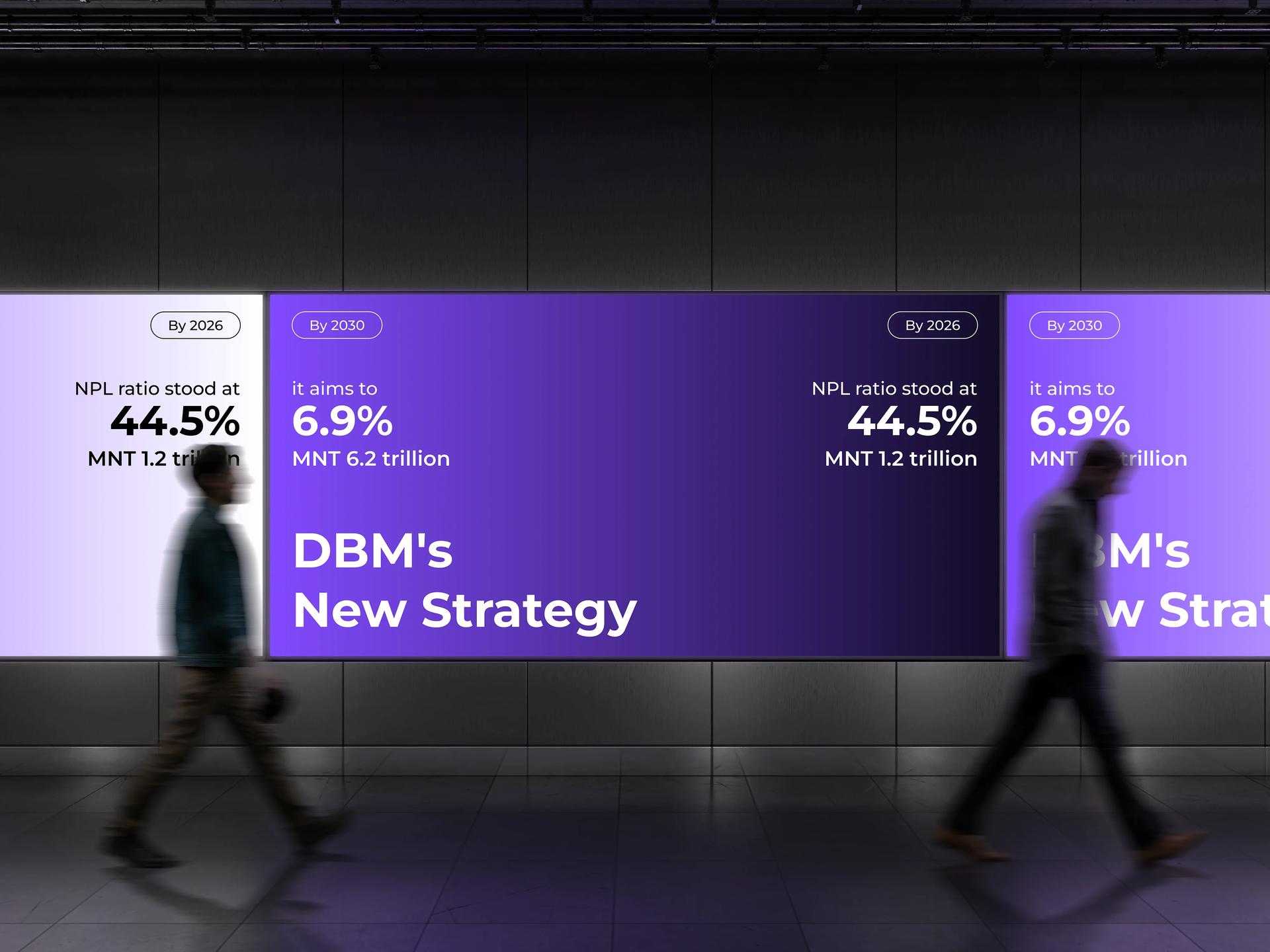
The new plan is built around four pillars: a sustainable, trusted, accountable and capable bank, underpinned by 19 objectives. By 2030, it aims to cut the non-performing loan ratio to 6.9%, extend MNT 6.2 trillion in new lending and turn the net interest margin positive.
The NPL target
At the end of August 2026, DBM's NPL ratio stood at 44.5%, with MNT 1.2 trillion non-performing loans outstanding. By 2030, the plan aims to recover MNT 718.2 billion from the legacy stock and reduce the ratio to 6.9%.
A significant part of that decline would come from a larger loan book. Recovering MNT 718 billion from MNT 1.2 trillion leaves about MNT 0.5 trillion of bad loans; against total loans of MNT 6.9 trillion in 2030, that is roughly 7%. Without new lending, the remaining MNT 0.5 trillion would represent around a quarter of the book. Investors should therefore track not only the ratio but how quickly the stock of bad loans itself declines.
New lending
DBM plans MNT 6.2 trillion of new lending over 2026-2030. In the base case, it will lend MNT 812.6 billion in 2026, MNT 1.8 trillion in 2027 and MNT 1.2 trillion a year in 2028-2030, with lending peaking in 2027 at almost a third of the total.
Demand is substantial. The plan cites 72 projects worth MNT 65.4 trillion in the 2026-2030 public investment programme that still lack funding, and 14 mega-projects worth MNT 36.3 trillion in the Government's action programme. DBM will prioritise energy, infrastructure, regional development and green projects, focusing on those commercial banks cannot finance.
Lending discipline will determine DBM's future credit trajectory. With the five largest borrowers already holding 60.7% of the loan book, and project demand more than ten times what the bank can fund, project selection criteria matter all the more.
Profitability
DBM currently earns less on its assets than it pays for its funding. At the end of August 2026, its net interest margin was minus 1.53% and its return on equity minus 30.8%. The plan attributes this mainly to interest-earning assets that are MNT 0.8 trillion smaller than interest-bearing liabilities.
By 2030, it aims to lift the net interest margin to 1.51% and return on equity to 4.9%. The plan assumes tugrik lending at 17.5% against a funding cost of 15.0%, and dollar lending at 10.0% against 7.5%, a spread of 2.5 percentage points in both currencies.
That is a relatively thin spread. The plan provisions 5% on new loans at disbursement, but a handful of large loans turning non-performing could quickly erase the income from that spread. The plan sets out a path to improve profitability, but leaves limited room to absorb deviations.
Capital adequacy
The MNT 1 trillion recapitalisation restored DBM's capital. The plan's own projections, however, show loan growth gradually eroding it.
The plan puts the capital adequacy ratio at 13.3% at the end of August 2026 and projects 10.9% by 2030. It sets two thresholds: below 11%, an alert; below 10%, new lending is slowed or suspended and shareholders are asked for additional capital. The base case's 2030 level already sits below the alert threshold.
Moody's recently upgraded DBM's standalone assessment to b3 from caa1, citing among the conditions for a further upgrade a capital adequacy ratio sustained above 12%. The strategy's base case falls below that level.
Government support therefore remains the cornerstone of DBM's credit profile. If the lending plan is delivered, the need for additional capital may return within a few years, which is when the draft law's mandatory equity restoration provision would become relevant.
Exchange-rate risk
The strategy's financial projections assume the tugrik depreciates against the US dollar by an average of 3.7% a year, from MNT 3,556.66 to MNT 4,263.5.
Most of DBM's debt is in US dollars, while 69.4% of its loans are in tugrik. The bank closed out a currency hedge in May 2026 and does not disclose its net open currency position. A sharp depreciation would therefore raise dollar debt service, measured in tugrik, faster than loan income.
The plan identifies depreciation of more than 10% a year as one of the main external risks. To mitigate it, DBM intends to raise the share of tugrik funding through its MNT 500 billion domestic bond programme, enter long-term swaps with the Bank of Mongolia and international financial institutions, and set limits on its open currency position. Even so, plans to raise MNT 7.5 trillion of funding over 2026-2030 mean the bank will remain dependent on international markets.
Legal framework and governance
Because the previous strategy failed to deliver on governance, the new plan's "Accountable bank" pillar deserves particular attention.
The plan includes passing the revised DBM Law, fully updating the related rules and regulations, introducing a whistleblower channel, independent staff selection, full documentation of committee decisions and performance-based pay. It also notes that since 2011 the Board has changed 12 times and the executive team 9 times.
Among the main risks the plan identifies is that the legal reform is delayed beyond 2027 for political reasons, or that current governance arrangements remain in place. The passage and implementation of the draft law remains a key indicator for bondholders.
Conclusion
The new strategic plan openly acknowledges past failures, attaches measurable targets to each objective and models its finances under base, optimistic and pessimistic scenarios. Setting limits on capital adequacy and non-performing loans, with pre-defined responses if they are breached, is a welcome step.
Ultimately, however, the plan will be judged on delivery. The indicators to watch over the next two years are clear: by 2027, DBM targets an NPL ratio of 36.3%, capital adequacy of 11.5% and MNT 2.8 trillion of funding through international and domestic bonds. Progress against these targets, the decline in the stock of bad loans, the concentration of new lending, exchange-rate movements and the passage of the law will show whether the strategy is being implemented.
The question is no longer whether DBM has a plan. It is whether the bank can meet the targets it has set for itself.
For more details on DBM’s 2026-2030 strategy, see the Development Bank of Mongolia’s 2026-2030 Strategic Plan.
To learn more, read our Bond Initiation Report: Development Bank of Mongolia.