Mongolia’s SIBs in Q3 2026: Earnings Rebound, Divergent Valuations
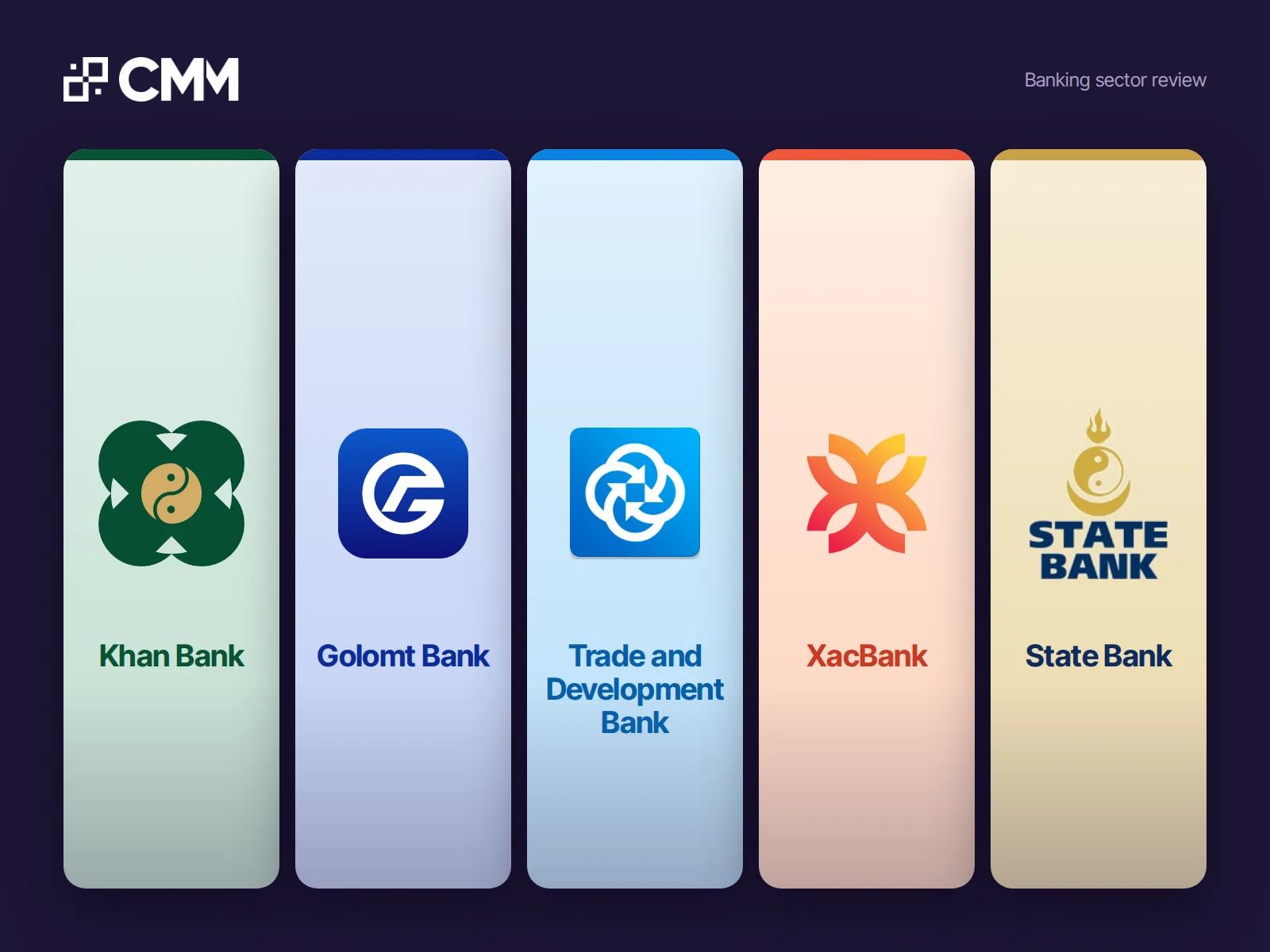
Mongolia's five systemically important banks (SIBs) delivered their strongest quarter of 2026 in Q3, reversing a soft first half. Combined net profit reached ₮473 billion ($131 million), up 54% YoY, driven mainly by core interest income rather than one-off gains. Asset quality broadly held, with TDB and Golomt the notable exceptions.
Equity investors, however, have drawn sharp distinctions between the five. Valuations have dispersed markedly since end-2025, rewarding Khan and XacBank while marking down TDB. Those prices are set in a thin, retail-driven local market whose structure shapes how fundamentals are priced, and where participation is now rising.
Below, we assess the quarter across three dimensions: earnings, asset quality and valuation.
Earnings: from a weak first half to the strongest quarter of the year
The first half set a subdued baseline. Inflation returned to double digits, household consumption softened, and combined H1 profit of ₮715 billion came in roughly 10% below the same period of 2025. Quarterly profit then built steadily through the year, from ₮325 billion in Q1 to ₮390 billion in Q2 and ₮473 billion in Q3.
The recovery was driven by core earnings. Net interest income (NII) rose 23% YoY to ₮875 billion ($243 million) and increased at every bank. Two factors underpinned it: the Bank of Mongolia's August policy rate hike to 12.5%, which lifted asset yields, and a ₮2.5 trillion net deposit inflow, concentrated at Khan, TDB and XacBank, at a time when banks sector-wide were sharply increasing holdings of central bank bills. Net fee income contributed a further ₮197 billion, while FX gains, a material support earlier in the year, fell to around ₮26 billion.
Performance by bank:
• Khan remained the sector's earnings anchor, reporting ₮194 billion in Q3, about 41% of the group total, on NII growth of 22% YoY.
• Golomt posted the sharpest recovery. NII, compressed in H1 by funding and other interest costs, rose to ₮130 billion from a quarterly average of ₮73 billion, and profit increased 2.6x YoY.
• TDB tripled its profit on 33% NII growth, although the headline figure was flattered by around ₮45 billion of provision write-backs and the absence of a tax charge.
• XacBank extended its run of sequential profit growth to a third quarter: ₮42.4 billion, ₮45.8 billion and ₮50.2 billion.
• State Bank grew profit 46% YoY on a 32% increase in NII.
Asset quality: broadly stable, with two exceptions
Credit deterioration has not accompanied the earnings recovery. Three of the five banks held or improved their non-performing loan (NPL) ratios over 2026. The exceptions are TDB, where NPLs are rising, and Golomt, where loan-loss coverage has thinned.
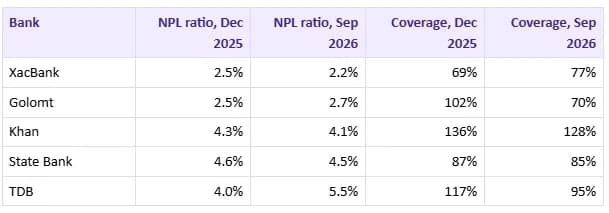
At TDB, NPLs reached ₮348 billion, up from ₮252 billion a year earlier, and the NPL ratio climbed from 5.0% to 5.5% within Q3 alone. Combined with the quarter's ₮45 billion in provision write-backs, this suggests part of Q3's profit may not recur.
At Golomt, NPLs rose from ₮210 billion to ₮238 billion over the year while reserves fell from ₮214 billion to ₮167 billion, taking coverage from 102% to 70%. Lower provisioning supports near-term earnings but leaves a thinner buffer against further deterioration.
Valuation: a widening divergence
The market has priced the five banks increasingly differently. At end-2025, price-to-book (P/B) multiples ranged from 0.54x to 1.19x. By 20 October 2026, that range had widened to 0.32x–1.72x.
XacBank and Khan were re-rated sharply higher, TDB was de-rated, and Golomt and State Bank were broadly unchanged. In aggregate, the five SIBs carry a market capitalisation of ₮7.7 trillion ($2.1 billion), equivalent to 0.93x combined book value.
Market structure: a thin but deepening local market
All five SIBs have been listed on the Mongolian Stock Exchange (MSE) since the 2021 amendment to the Banking Law required systemically important banks to go public. Beyond strategic and state shareholders, their shares are held and traded mainly by local retail investors. Three features of this market shape price formation:
• Low turnover. In Q3, the five banks traded a combined ₮297 million a day, about $83,000. Year to date, less than 1% of their ₮7.7 trillion market capitalisation has changed hands.
• Limited free float. The law caps any single shareholder at 20%, yet strategic and state holders retain the majority of shares. At State Bank, the state held about 94% at listing, leaving roughly 6% in free float.
• Weight on visible signals. Headline profit, dividends and price momentum carry outsized influence. Khan's ₮214 per-share dividend, a yield of about 10%, and XacBank's three consecutive quarters of profit growth have been rewarded. At TDB, rising NPLs have outweighed reported profit growth.
Illiquidity is a genuine constraint. Prices can diverge from fundamentals for long periods and exits can be slow, which helps explain how a bank generating a return on equity near 20% can trade at around 0.6x book.
That constraint is beginning to ease. Average daily trades in the five SIBs rose from about 320 in H1 2025 to 470 in H1 2026, around 680 in Q3, and roughly 900 so far in October. Average daily traded value increased from about ₮236 million to ₮338 million between the two half-year periods.
If retail participation continues to broaden, prices should track fundamentals more closely, with the greatest effect where discounts are widest. That is where improving liquidity would matter most. The same thin liquidity cuts both ways, however, leaving prices exposed to sharp moves on small volumes.
What to watch in Q4
• Policy rate direction. Banks took in a ₮2.5 trillion deposit inflow in Q3 while loan growth was just 0.5%, and central bank bills at 12.5% have been a key outlet for that liquidity. Government bond yields point to easing; any rate cut would hit this income stream first.
• TDB asset quality. Whether NPLs continue to rise once the Q3 write-backs are excluded, and how the Q4 tax charge affects full-year profit.
• Golomt provisioning. Rebuilding coverage from 70% would weigh on earnings; a further decline would raise risk concerns.
• Trading activity. Whether daily trade counts keep rising after the Q3 rally, indicating broadening participation rather than momentum-driven flows.
Bottom line
Q3 reversed a weak start to 2026. Profit rose by more than half on the back of core income rather than one-off items, and asset quality largely held. The equity market, thin and locally driven, has been far more selective, rewarding some SIBs considerably more than others. If trading activity continues to deepen, valuations may align more closely with underlying earnings.
Full report
cmm_sibs_q3_cover.webp
WEBP · 46 KB