Mongolia has been absent from the world’s mining-finance capital for three decades. A listing, a mandate and a roadmap suggest that is finally changing.
The missing flag
London has, at one time or another, financed almost every resource economy on earth. Chilean copper, Kazakh uranium, Ghanaian gold: all have flags planted somewhere in the Square Mile. Mongolia, sitting on one of the world’s great mineral endowments, is the glaring exception.
The exceptions prove the rule. Rio Tinto, the mining giant, is arguably the biggest Mongolia play in London. Its most important growth asset is the Oyu Tolgoi copper mine in the South Gobi, controlled outright since Rio bought out Turquoise Hill in 2022. But buying Rio for Mongolia exposure is like buying a food conglomerate for the chocolate. Beyond that, the London roster is essentially Petro Matad, the oil explorer that listed on AIM back in 2008 and has flown the Mongolian flag there more or less alone ever since.
The rest of the Mongolia story has been told on other people’s exchanges. Its exploration and mining assets have historically listed in Toronto; two Mongolian gold miners, Erdene Resource Development and Steppe Gold, ranked among the TSX’s top performers last year. Sydney is taking a growing share, with a steady stream of Mongolian juniors heading for the ASX. The country’s biggest company by market capitalisation, Mongolian Mining Corporation (MMC), has traded in Hong Kong since 2010, and nearly $6 billion of Mongolian bonds trade in Singapore. Yet London, home to the deepest pool of mining and emerging-market capital anywhere, somehow ended up with the smallest allocation.
Not for lack of trying
In January 2011, at the height of Mongolia’s boom (GDP grew more than 17% that year), the London Stock Exchange Group signed an exclusive strategic partnership to modernise and help run the Mongolian Stock Exchange. LSEG placed managers in Ulaanbaatar, installed its MillenniumIT trading engine and put a generation of brokers and regulators through its academy. The technology worked; the market around it did not yet exist. With a handful of active brokers, no institutional investor base and minimal free float, the MSE got a Formula 1 engine before anyone had built the racetrack. The exchange’s real development would come more than a decade later, under local stewardship.
Then came the Tavan Tolgoi saga. For much of the 2010s, Mongolia planned to float Erdenes Tavan Tolgoi, operator of one of the world’s largest untapped coking-coal deposits, in a $3 billion IPO spanning Hong Kong, London and Ulaanbaatar. Banks were mandated, prospectuses drafted; elections happened, coal prices moved. By 2017, the government was telling Nikkei that an international IPO was “no longer needed.” London shrugged and moved on.
Two attempts, two lessons: infrastructure without issuers is a showroom, and a single mega-asset IPO is hostage to a single moment of political and commodity alignment.
So what’s changed?
Three things. For once, Mongolia is not coming to London with a single asset and a promise. It has several compelling stories to tell at once.
First, actual listings. In January 2025, Invescore Financial Group (ICFG) was admitted to the Main Market of the London Stock Exchange, becoming the first Mongolian company ever to list in London. Modest in size, major in signal: a Mongolian financial group can meet LSE standards, get admitted and trade. More consequentially, Mongolia’s large banks, Golomt Bank among them, are actively preparing for international listings. Banks are the broadest possible proxy for an economy; when they come to market abroad, Mongolia stops being a single-asset story.
Second, the government has brought in professionals. In July 2026, the Government of Mongolia signed an agreement with Franklin Templeton to explore consolidating stakes in state-owned enterprises into an investment fund, offering units to professional investors on domestic and international exchanges, with a first portfolio targeted for international markets by the end of 2027. The template already exists, and it works: the Uzbekistan National Investment Fund (UzNIF), managed by Franklin Templeton, listed on the LSE in May 2026 after a $604 million IPO, one of London’s largest in recent years and Uzbekistan’s first international equity offering. Mongolia has just signed up to do something very similar. And note the structural difference from the Tavan Tolgoi era: instead of betting everything on one giant asset going public at one perfect moment, this is a diversified portfolio, prepared to international valuation and governance standards, with a manager who has run this exact play before.
Third, the home market finally works. A 2021 banking law pushed Mongolia’s systemically important banks to go public, and they did: Golomt Bank’s 2022 IPO and Khan Bank’s 2023 IPO were the largest in the exchange’s history, drawing tens of thousands of first-time retail investors. Market capitalisation has multiplied several times over from the mid-2010s, domestic institutional money is entering the market, and a genuine IPO culture exists. The index providers have noticed: in September 2025, Khan Bank became the first Mongolian company included in FTSE Russell’s Frontier Market Index, putting Mongolia on the same screens as Kazakhstan and Vietnam. The 2011 problem has inverted: then, Mongolia had London-grade infrastructure and no market; now it has a market whose best issuers are ready for deeper pools of capital. An international listing is no longer a leap into the void; it is the next step on a staircase that already exists.
Two tailwinds
Critical minerals. In mid-2025, the UK and Mongolia signed a roadmap for cooperation on critical minerals, and the British Geological Survey is working with Mongolian counterparts on mapping and surveying the country’s endowment. The logic is straightforward: the UK wants diversified supply chains for the minerals underpinning the energy transition; Mongolia has copper, rare earths, fluorspar and more, and wants Western capital and “third neighbour” partnerships to develop them. Between a strategy and a mine sits, inevitably, a financing, and financing mines is the oldest trick in London’s book.
The neighbourhood effect. London investors have spent the past eight years building positions, and just as importantly mental models, in economies that look remarkably like Mongolia’s. Kazatomprom raised $451 million in London GDRs in 2018. Kaspi.kz’s 2020 London IPO made it the most valuable Kazakh listed company in history. Air Astana’s $370 million triple listing in February 2024 ranked among the LSE’s largest IPOs that year, and Uzbekistan made its sovereign-bond debut on the LSE in 2019. Resource-rich, landlocked, positioned between Russia and China, reforming state enterprises, young and digitising fast: an investor who has done the work on Kazakhstan or Uzbekistan does not need Mongolia explained from scratch. The analytical framework transfers and the risk rhymes: Mongolia arrives in London not as an exotic one-off, but as the next name in an asset class the City already owns.
September in London
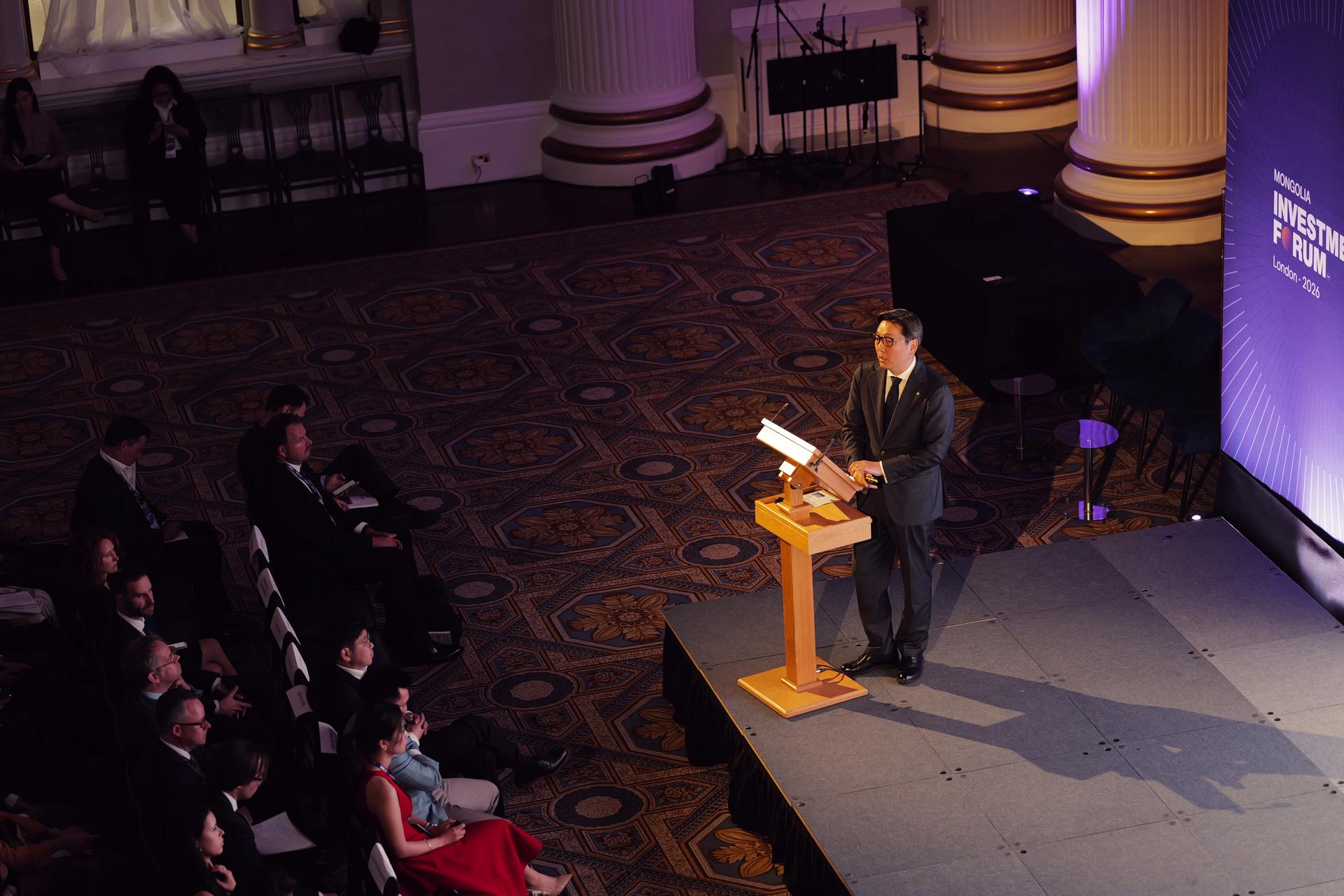
This is the backdrop for the Mongolia Investment Forum: London 2026, which Capital Markets Mongolia hosts on September 15. The inaugural London edition, in October 2025, brought Mongolia’s Deputy Prime Minister and the British Ambassador to Mongolia together with the country’s leading banks and issuers on the London Stock Exchange’s own stage. The 2026 edition convenes at a moment when every thread above is live: a bank-listing pipeline forming, the Franklin Templeton portfolio working toward its 2027 target, and a critical-minerals partnership moving from communiqué to fieldwork.
For international investors, the calculus is simple: the most interesting time to meet a market is before its listings arrive, not after. Each of these threads points to a two-to-three-year window in which Mongolia’s London presence goes from near-zero to meaningful, and the people building that presence will be in one room this September. Attendance is by invitation, via capitalmarkets.mn.
Mongolia’s presence in London has been close to non-existent for the entire modern history of its capital markets. That was a fact; it is fast becoming a dated one. Mongolia is eyeing London again, and for the first time, London has good reasons to look back.